
Replacing a lock cylinder at home is child’s play if you have the correct measurements. Here is how to measure accurately so you buy the right size on your first try!
Before buying a new lock cylinder, the most common mistake customers make is choosing a product “by eye” or based only on the total length of the lock. However, the world of lock cylinders is not that simple: locks are almost never completely symmetrical, so knowing the exact external and internal dimensions is essential for safe and aesthetic operation.
If the lock cylinder is too short, you won’t be able to turn the key past the door handle or the escutcheon. If it is too long, it will protrude from the plane of the door, which is not only unsightly but also poses a serious security risk (burglars can snap the lock much more easily).
The Secret: The Fixing Screw is the Center Point
When sizing a lock cylinder, the most critical starting point is the fixing screw hole. All dimensions are measured from this point (the center of the hole) in two directions: towards the external and the internal side.
Lock cylinder sizes are always specified using two numbers (e.g., 30/35 or 40/40). The first number usually represents the length of the external side (A), while the second is the length of the internal side (B) in millimeters.
How to Measure? – The Two Easiest Methods
Method 1: Measuring the Removed Lock Cylinder (The Most Reliable Way)
If you have the opportunity, you will get the most accurate result by removing the existing lock cylinder from the door.
- Open the door and locate the cylinder fixing screw on the long metal faceplate on the edge of the door (directly below the latch/deadbolt).
- Unscrew this retaining screw completely.
- Insert the key into the lock, turn it slightly (about 10-15 degrees) so that the cylinder cam (the small black rotating tongue) aligns flush with the body of the cylinder, then gently pull the cylinder out.
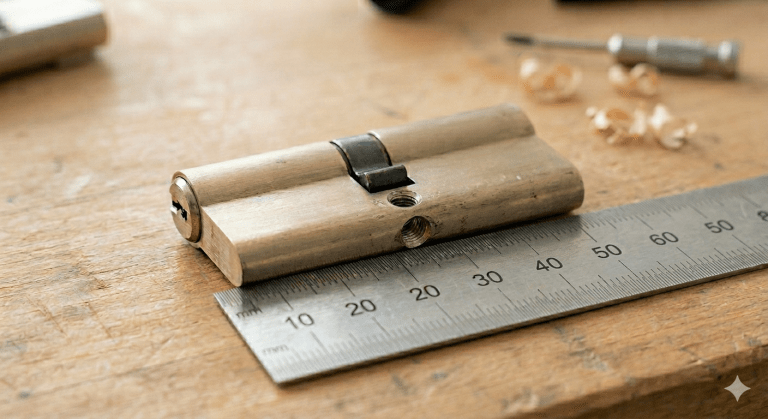
- Using a ruler or tape measure, measure the distance from the center of the fixing screw hole to the external edge of the cylinder (“Side A”), then the distance from the center of the hole to the internal edge (“Side B”).
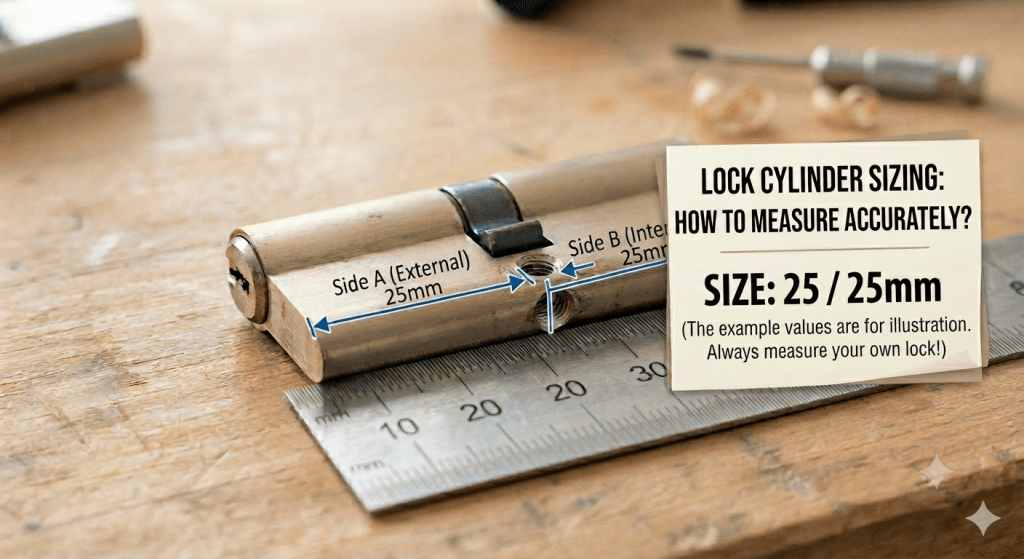
Figure 1: For a removed cylinder, use a tape or a ruler measure to determine both sides from the center of the hole.
Method 2: Measuring from the Door (Without Removing the Lock)
You can also measure the required size while the lock is still inside the door, but you must take the backplates (handle plates or rosettes) into account!
- Open the door and locate the fixing screw on the edge of the door.
- Starting from the center of the screw, measure out to the external plane of the door (including the handle plate or rosette!). This will be your “A” dimension.
- In the same way, measure from the center of the screw to the internal plane of the door (including the rosette/plate as well). This will be your “B” dimension.
 Important Golden Rule for Security!
 Important Golden Rule for Security!
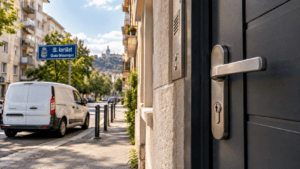
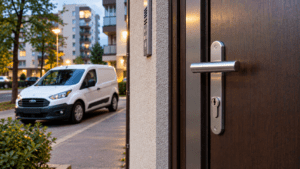
The fully installed lock cylinder should protrude from the external plane of the door (the protective plate or rosette) by a maximum of 3 millimeters! If it sticks out further, burglars can easily grip it with a specialized tool, snap it, and open the door in seconds. If your measurement falls right between two sizes, it is always safer to choose the smaller one or the one that sits exactly flush with the security plate.